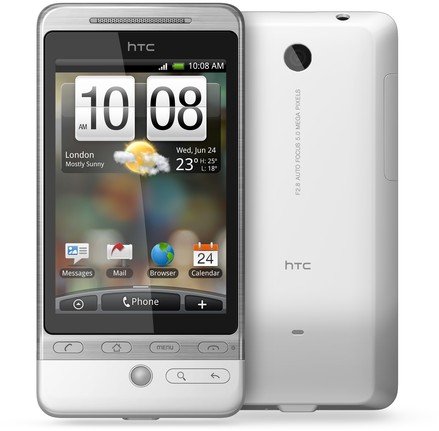
I've been wowing over these two devices approximately for the last couple of months, and decided that it's finally time to make a decision.
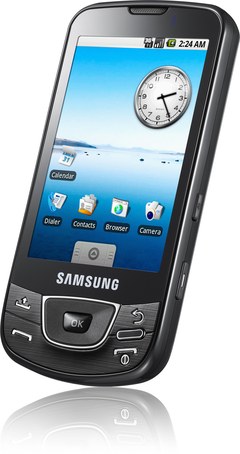
Both the Samsung Galaxy and the HTC Hero use the same SoC (who isn't?) - the Qualcomm MSM7200A, a 528 MHz ARM1136EJ-S core, using the ARMv6 ISA. The MSM7200 includes a 3D acceleration unit and a Qualcomm DSP, making it very suitable for any multimedia application. I do believe that the 3D acceleration unit still lacks full support under Linux/Android (much like the OMAP3530/PowerVR). Both handsets have a 5MP camera, although no secondary camera for video calling. They both have 802.11b/g, bluetooth, etc. The display on both devices is 320x480 pixels. Major differences are that the Galaxy has several more buttons (e.g. volume control), much more internal storage space, and a very power efficient AMOLED display, while the Hero sports the new Sense(R) UI, integrated Adobe Flash, more RAM, and multi-touch support.
I thought I would summarize. For those who would like to see a detailed comparison of the two devices, check out this link from pdadb.net .
| HTC Hero | Samsung Galaxy | |
|---|---|---|
| RAM (MB) | 288 | 128 |
| Flash (MB) | 512 | 7630 |
| Connector | ext-USB (mini-USB compatible) | micro-USB |
| Battery (mAh) | 1350 | 1500 |
| Display Depth | 16-bit (65-thousand colours) | 24-bit (16-million colours) |
| Display Type | Transflective TFT (standard) | AMOLED (very low power) |
| Multi-Touch? | YES! | NO! |
| Price (€) | 485,97 (Amazon.de) | 476,98 (Amazon.de) |
So far, I have not had a chance to examine either of these devices in any detail, but from what I have read, the Hero does support multi-touch. Until now, most sources have stated that the Galaxy does not support multi-touch. However, that might only be due to the fact that Android did not support multi-touch in software until the Hero came out. Perhaps the Galaxy has hardware support for multi-touch. Who knows with any certainty? I've read that the Galaxy actually has a capacitive touchscreen, so multi-touch does not seem that far off. The Galaxy also lacks Google-branding, which (aside from lacking some cover-art) means that software updates are not transferred over the air. Rather, updates must be performed manually with a USB cable, which some users might actually prefer.
Let's start with the Hero. I like that it has a large amount of RAM a great UI that supports multi-touch. The RAM will come in handy for streaming media (i.e. video) and fast context switching (Android's OOM process killer will not be called as frequently). As for multi-touch, I think you would probably agree, that there really is no alternative for pinch-zooming in the browser, or easy photo rotations. Now, the Galaxy - the fact that it's missing some RAM has been somewhat accounted for with the built-in 8GB of storage. As far as the screen goes, AMOLED spells very low-power (I love it) and still supports a true-colour (16million level) display. That will make it excellent for viewing any type of video or looking at photos. However, if the Samsung hardware truly does not support multi-touch, then I would be quite disappointed.
I have to admit, that I'm still sitting on the fence about this until I know with any certainty that the Samsung does not support multi-touch. Originally, I was thinking that the Samsung would be the best choice, without a doubt, but now I'm really considering how the extra RAM in the Hero might be beneficial. In terms of permanent storage, the Hero has more than enough, and is expandable with a micro-SD card anyway. On the other hand, the Galaxy could easily host a few operating systems on-board, or perhaps my entire collection of (decent) mp3s. This decision would definitely be easier if I knew for a fact that the Galaxy hardware did or did not support multi-touch.

